Church History
In 1874, the first Methodist church was founded in Bingham Canyon, about the same time as the first mines were established. In March 1899, a bell was purchased for the church and installed in the belfry where for years it rang every Sunday calling the people of the small mining community to worship. Today, that bell is in our entryway.
The Highland Boy Community House was a Utah Mission project of the Woman's Society of Christian Service. The Highland Boy Community House was located in the Carr Fork of Bingham Canyon and for years it had served all residents regardless of nationality or religious background. Kennecott Copper eventually expanded its mine to include the Highland Boy community, so the Community house relocated to Bingham Canyon and the building was demolished.
Meanwhile, Methodist worship services in the community of Copperton began in 1937. Like the services of the local LDS ward, Methodist meetings were first held at the Copperton Elementary School.
In 1957, Kennecott Copper Corporation bought all the church property of the Bingham Canyon Methodist Church, so the Highland Boy Community House also combined with the Copperton congregation and the name of the church was changed to St. Paul Community Methodist Church. Furnishings from the church, including the a 1917 reed organ, piano, pews and pulpit, bell, and the wood paneling now lining the walls of the basement were moved to Copperton.
In 1942, Kearns Army Air Base was conceived as a temporary training center, training airplane crews for the war effort. Workers from Intermountain Contracts arrived on June 15, 1943 and started work the following day with the construction of Camp Kearns. Research indicates that sometime between June 15, 1943 and October of 1943 four identical chapels were built at Kearns. Since few records of temporary bases were kept, estimates are that at least 90,000 men went through Camp Kearns each year. That meant that Camp Kearns was the third largest city in Utah during the War.
The war ended in 1945 and Kearns Army Base was ordered to close in late November of 1946. As part of the demobilization which followed the war, in 1947 the War Assets Administration declared Kearns Army Air Base surplus and made many of its buildings available to people who wanted to relocate and reuse them.
So Kearns was classified by the War Assets Department to auction everything off to be sold to the highest bidder.
When it appeared that they might be able to obtain one of the four chapels from the Air Base, members of the Methodist Community in Copperton began raising funds to construct a basement and to move the building. In February 1947, Kennecott Copper Corporation offered to provide a parcel of land if the Methodist church could obtain a chapel from the recently closed camp. Kennecott Copper Corporation donated a lot adjacent to mine property and next door to the site of the Copperton LDS ward.
One Sunday, September 7, 1947, a group of Methodists from Bingham, Copperton, and Lark traveled to Kearns and held their first worship service in the chapel. This was also the last service to be held there before the building was cut into sections and moved to Copperton. It would be nearly three years before the chapel could open and hold services again.
in May, 1948, ground was broken for the basement of the church. By August 1948, all the preparations had been made to move the chapel to its new site. Moving the bulky building was no easy task since the only road that approached Copperton from Kearns goes underneath the railroad underpass that is still there today. In the first step of the moving process the chapel was cut in half, and the steeple was removed. To avoid the underpass, the sections were driven along a dirt road to the north of the main highway. Kennecott Copper Company linemen took down some electrical lines and held others up to provide the necessary clearance for the building.
Two years later, in 1950, after many delays and setbacks, services were finally held in the Copperton Community Methodist Church to serve the people of Copperton and Lark. As mentioned earlier, in 1957, they were joined by members from the Bingham Canyon and Highland Boy churches.
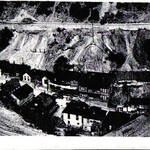
The black and white historical photos of Bingham Canyon listed below were found in the church records, and will give you a flavor for the community that St. Paul grew up in.




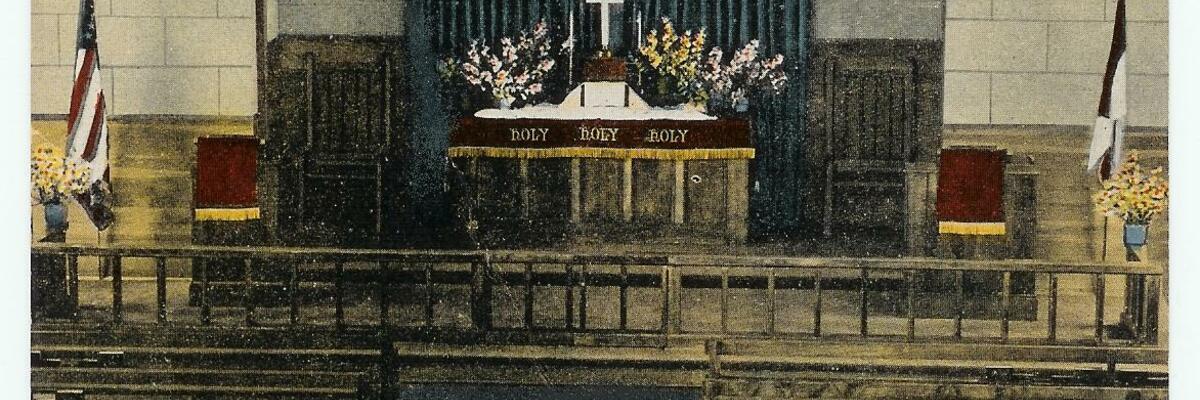
Copperton's Methodist Church building is a good example of a type of building that is becoming increasingly rare – a World War Two mobilization building. Tens of thousands of these buildings were constructed at bases all across the nation in the early 1940's. Almost all mobilization buildings were built according to standardized plans. Ease and speed of construction were the key design criteria for these buildings, since bases that could house thousands of soldiers had to be build in the space of a few short months. Mobilization buildings were intended to be temporary. Like all other buildings constructed for a temporary military base, it was built to last only seven years at the most.
World War Two mobilization chapels served all faith communities, but their design was patterned after that of a New England Protestant meetinghouse with a lightning rod rather than a cross affixed to the steeple. Like most mobilization buildings, their wood ship-lap exteriors were originally painted ivory. The iconic appearance of the building immediately identifies it as a sacred space.
The one and a half story building is divided into seven bays. The first bay is occupied by the entryway, church office, and overhead choir loft, the end bay contains the altar and side rooms. The five centrals bays that form the sanctuary are open to the roof to expose the buildings most attractive feature – braced hammer beam trusses.
Some alterations have been made over years to the building including the replacement of the original five panel front doors and the addition of vinyl siding to the exterior of the building. Shortly after the church communities merged, the choir loft was closed off and became a storage area. In April 2014, church members opened it up again, remodeled it, and returned it to its original purpose as additional seating. While we continue to maintain and upgrade the building as time and finances allow, we are committed to retaining the original look and feel of the building much as it looked when it was first built in 1942.
Over the years, we have looked for other examples of this type of church building that are still standing. One chapel is located at Hill Air Force Base, near the museum. It has been extensively remodeled and upgraded over the years, and it's interior appearance is much altered from the original design. Another former chapel building is located adjacent to the Wendover Air Field, in Wendover, Utah. It has been converted into an apartment building.
Army Chapel number stenciled on wall in back room of building
After several years of research and work, in November, 2006, St. Paul's building was added to the Utah Historical Register, and we received a plaque and certificate to commemorate the event. The plaque is located in the narthex, adjacent to the front entrance. Much of the information included in this history came from the research prepared for the Historical Register submittal. We are indebted to Pam Todd of the Kearns Historical Society for all her work on the history and submittal.
The Church is a popular filming location for television and movie productions, and has hosted many such activities over the years. The long running television series “Touched by an Angel” filmed several episodes at the church, and the gazebo in our side yard was build by their crews as a prop. In 2005, the film “Dark Matter” shot several scenes at the church. Some congregation members even appeared as extras in the film. In January, 2007, the film was premiered at the Sundance Film Festival. In 2013, the BYU-TV series “Granite Flats” filmed a couple of episodes at the church. Most recently, in 2023, the local movie production of “Faith of Angels” filmed at the church. The movie, which premiered in 2024, was the story of a young boy who was lost in an abandoned Utah mine back in 1989. We are proud to be able to show of our church in film and television, and have benefited from the income it has provided to maintain and upgrade our facility.
There are two memorial plaques in the narthex (front lobby) of the church. One plaque commemorates Highland Boy residents that served in World War 2, and the second plaque commemorates members of Bingham Canyon that served in World War 2. In addition, a memorial roll commemorates family and former members of St. Paul that were remembered at a May 26, 1996, candle lighting ceremony.
There is a memorial pathway on the church grounds that leads from the front of the church to the gazebo. It contains bricks with the names of people associated with Copperton and the other mining communities in Bingham Canyon. Also persons associated with the St Paul community.
Download Listings below